
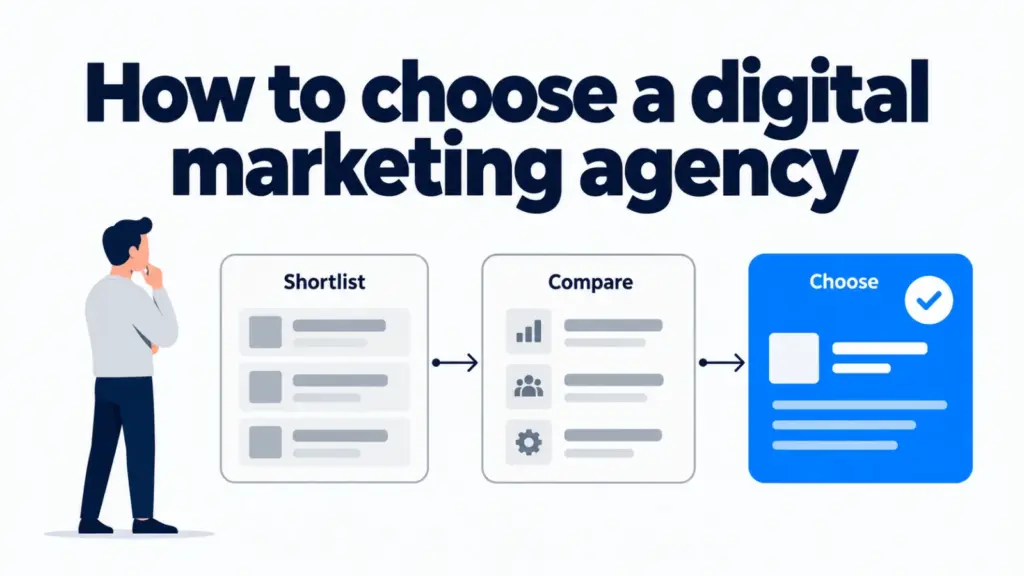
Choose a digital marketing agency on evidence you can check, in the order it reaches you: the website, a call, a past client, a proposal and a contract. The website comes first, and it is lopsided. Of 39 agency websites read in October 2026, 32 show a named client with a result figure. Sixteen of the full 40 print a price, and six say how long a contract runs or how it ends. The claims are free to read. The cost and the exit have to be asked for.
The short version
- Of 39 agency websites read in October 2026, 32 show a named client with a result figure, and nine give the size of the team as a number.
- Sixteen print a price and six state a term, a notice period or a cancellation rule. Ask for both in your first message.
- A result with no starting number and no period can’t be checked. Ask for both, then ask to speak to the client.
- Google’s guidance says no one can guarantee a number-one ranking, and tells buyers to check references.
- Three to five agencies answering one written brief give you proposals you can compare.
Decide whether you need an agency at all
An agency suits work that needs several skills at once and can’t stop when one person is away. Other work is better bought another way.
| Your situation | What fits | What you give up |
|---|---|---|
| One defined task that needs one skill, such as running a Google Ads account | A freelancer | Cover when that person is ill, busy or gone |
| Several skills working together: ads, landing pages, tracking, content | An agency | Part of the fee pays for managing the account, and the team has other clients |
| Marketing is daily work and the need is steady all year | An employee | Range: one person has one set of skills, and the salary runs whether or not the work does |
| A small local business that wants to be found in search | Starting it yourself | Your own time |
The last row is Google’s own view. Its guidance on whether you need an SEO says a small local business can probably do much of the work itself. It adds that knowing the basics helps you judge anyone you hire later.
One discipline or several
Shortlist by the channel that carries your goal. If paid search is the whole job, an agency that does only paid search is a fair candidate, and so is a larger one with a paid search team.
If the goal needs search, ads and a new landing page to work together, someone has to coordinate them. That is one agency covering all three, or you. A long list of services proves little by itself, so check that the case studies cover the service you’re buying.
Write the brief before you look
Write down the outcome you need, the budget you have and the date that is real before you contact anyone. An outcome has a number, a market and a date: “forty qualified enquiries a month from the UK by March”. “More leads” has none of the three.
An agency prices against a scope, so a vague brief is priced for the worst case. The enquiry form won’t do this for you: of 22 agency enquiry forms read in October 2026, four ask for a budget. How to write an agency brief sets out what to state, and how to state the budget.
Build a shortlist from facts, and stop at five
Filter first on what is simply true or false: the service you need, the market you sell in, your sector, and an agency of a size that fits the job. Those cut a long list to a handful without anyone’s opinion.
Three to five agencies is enough. Each one you add is another proposal to read, another call and another reference to take up. Each agency also spends unpaid time on a proposal it may not win.
Selection takes weeks. Say you allow one week to write the brief, three for proposals, one for calls and references, and one to agree the contract: that is six weeks. Those figures are an example. The steps you control are the brief and your own approvals, so settle who signs before you start.
What a listing in this directory tells you, and what it doesn’t
A listing here tells you what an agency offers and where it is based. Each profile is compiled from the agency’s own website and says so on the page. Start from the agencies list, or from a service page such as SEO agencies, and filter by service, industry and team size.
It doesn’t tell you how good the work is. A listing can carry the Verified badge for passing four checks, set out in how agencies are verified. The business trades under the name given, and its contact details resolve to it. The services claimed match demonstrable work, and the stated minimum budget reflects real engagements.
A listing shows the badge only once it has passed those checks, and a score only once the agency has claimed its listing. Until then the profile says it is unclaimed and not scored. The team-size filter shows only the listings that state a size. Use the directory to find who offers what in which city. Take the rest from the agency’s own site and from the questions below.
What 39 agency websites show before the first call
An agency’s site shows results freely and says little about price, people and terms. The counts below come from the websites of the 40 agencies profiled in this directory. Thirty-nine could be read as text in October 2026: the home page and, where the site has them, an about or team page and the work or case-study pages. The price and contract rows count all 40, as the two pieces that go deeper do. The counts describe these sites and no wider market.
| Look for | Sites that show it | If it’s missing, ask |
|---|---|---|
| A case study with a named client and a result figure | 32 of 39 | Which client is closest to my business, and can I speak to them? |
| A statement that work is done in-house, by senior people or directly by specialists | 22 of 39 | Which roles will work on my account, and for how many hours a month? |
| A price, a rate or a starting figure | 16 of 40 | What is the smallest engagement you take? |
| The size of the team, as a number | 9 of 39 | How many people do the work I’m buying? |
| An award with the awarding body and the year, in words | 8 of 39 | Who gave it, when, and for which client’s work? |
| A contract term, a notice period or a cancellation rule | 6 of 40 | What’s the minimum term, and how much notice ends it? |
Price and terms are the rarest facts on these sites, and they are the two that decide your cost. Ask for them in your first message. What agencies publish about price shows what the 11 printed figures include and leave out.
What the statements about people are worth
“In-house” and “senior” are easy words to print, so the firmer statements are the useful ones. Two sites say you deal with the specialists directly, with no account manager between. One prints a ratio of three in-house staff to each client account, and one says its developers are outside partners. Ask every agency for its own version of that sentence.
Awards and partner badges
An award helps you only when you can look it up. Twenty-nine of the 39 sites mention awards, and eight name one with its body and year in words on the pages read. A platform partner badge is the platform’s label. Ask which tier it is, and read the platform’s own page on what that tier requires.
How to check a case study
A case study can be checked when it gives four things: the client’s name, the starting number, the end number and the period. On 32 of the 39 sites, a case study names the client and gives a figure. Four more name their clients and give no result figure on the case studies opened. One gives figures for clients it doesn’t name, and two have no case-study pages.
The starting number is rarer. On at least nine of the 32, a case study opened for this guide says where the figure started as well as where it ended. Say leads rose 150%. That tells you nothing until you know whether they began at 20 a month or 2,000.
Then check what was measured. Traffic, impressions and rankings move before sales do, and the agency chooses which to show. Ask what the same work did for enquiries or revenue, over what period, and who counted.
Open the case study itself, too. A tile on a home page carries the figure without its scope. The figure is the agency’s own report in every case, and a conversation with the client behind it is the better test.
Take up a reference, and ask about the worst month
Ask each agency on your shortlist for two clients you can call. None of the 39 sites offers this on the pages read, so it is yours to ask for. Google’s guidance says to check business references. It suggests asking past clients whether the service was useful, whether the agency was easy to work with and whether it produced positive results.
Add questions that have factual answers:
- Who did the work day to day, and did that change after the first months?
- What happened in the worst month, and how did you hear about it?
- Did the price or the scope change after signing?
- What did a monthly report contain?
- Would you sign the same contract again?
Ask for one client who has left as well as one who stayed. A quote on a website was chosen by the agency. A call lets you ask what the quote wasn’t chosen to answer.
Questions for the first call
Google’s questions for hiring an SEO work for any discipline. Ask for examples of previous work. Ask what results the agency expects, in what timeframe, and how it measures success. Ask about its experience in your industry and your country, how you will communicate, and whether it will share every change it makes with the reasoning behind it.
Then add the questions that decide cost and control.
| Ask | A useful answer | A reason to keep looking |
|---|---|---|
| Who will work on my account? | Named roles and hours each month | “A dedicated team” with no numbers |
| What will you report, and when? | A sample report and a date | A promise of “full transparency” |
| What is not in the price? | A list: ad spend, tax, extra rounds, set-up | “Everything is included” |
| Whose name are the ad accounts in? | Yours, with the agency given access | “We set them up for you” |
| When will I first see evidence? | A date and a named measure | A guaranteed ranking, or a date for page one |
Count the questions the agency asks you as well. Google’s guidance says a candidate worth hiring asks what makes your business unique, who your competitors are and how your customers find you. An agency that asks nothing is quoting for a business it hasn’t looked at.
Some answers end the conversation: a refusal to say who will do the work, no sample report, a price that expires this week. None proves poor work. Each is a reason to ask a second question before you sign.
Why a guarantee is a reason to ask more
A guarantee tells you what an agency is willing to promise, and some results aren’t an agency’s to promise. “No one can guarantee a #1 ranking on Google,” Google’s guidance says. It warns against anyone who claims a special relationship with Google, and against a company that is secretive about what it intends to do. How long SEO takes explains why no date can be promised either.
Four of the 39 sites print a guarantee of their own. One says its team works for free after six months if revenue hasn’t risen. One advertises a money-back guarantee, one a “results guarantee”, and one guarantees client satisfaction. Each is the agency’s promise, so ask for it in the contract: what is guaranteed, how it is measured, and what you receive if it’s missed.
Compare proposals on the same four things
Proposals compare only when they answer the same brief by the same deadline. Set four things side by side. The scope is exactly what is delivered. The people are who works on it, and for how many hours. The costs on top are ad spend, tax, extra rounds and set-up fees. The term is how long you are committed.
Say one agency quotes $3,000 a month for 20 hours and another $5,000 a month for 40. The second costs less per hour, $125 against $150. The cheaper-looking one may be the better value or the thinner one, and only the list of what the hours cover tells you which. Those figures are for illustration only.
Read the contract for how it ends
Three clauses decide how a contract ends: notice, ownership and handover. The notice period is the longest you can be held to work that isn’t performing. Ownership says whether the ad accounts, analytics, domains and creative files are yours. Handover says what the agency must pass back, and how fast.
A 12-month minimum with 30 days’ notice can commit you to 13 months, where notice can’t be given until the minimum ends. Six of the 40 sites state a term, a notice period or a cancellation rule before you ask, so expect to raise it yourself.
Agency contracts: notice periods, ownership and handover goes through each clause. This guide is general information, not legal advice.
Start with a smaller commitment
A first engagement can be smaller than the contract you expect to sign. Ask for a single project, a paid audit or a three-month first period with a review, before a 12-month retainer. Some agencies will say no, and that is worth knowing.
A paid audit is a fair test only if it is real work. Google’s guidance says an audit should give you realistic estimates of the improvement and of the work involved. At that stage, it says, grant only read access to Search Console, Google’s reporting tool for site owners. The article on real SEO audits and tool exports lists what to look for.
Ask whether a shorter term changes the monthly price. Weigh the difference against the cost of being held to work that isn’t performing.
Settle four things in the first three months
The first three months show whether the agency you chose is the one you got. Settle four things before work starts.
- Put every account in your name: ad accounts, analytics and the domain, with the agency given access.
- Record a baseline for each measure you agreed.
- Agree what the monthly report contains, and see a sample.
- Put two review dates in the diary: one when the first evidence is due, and one when you decide whether to continue.
For paid search, how to read a PPC agency’s monthly report lists what a report should show. For search work, ask for early measures such as impressions and indexed pages, which move before sales do.
If the people on the first call aren’t the people in the first report, ask why.
Send one brief to three agencies
Pick three agencies from your shortlist and send each the same brief on the same day, with the same deadline. In the same message, ask the two things their websites are least likely to tell you: the smallest engagement they take, and the minimum term with its notice. The replies are your first evidence of how each agency will handle your account.