
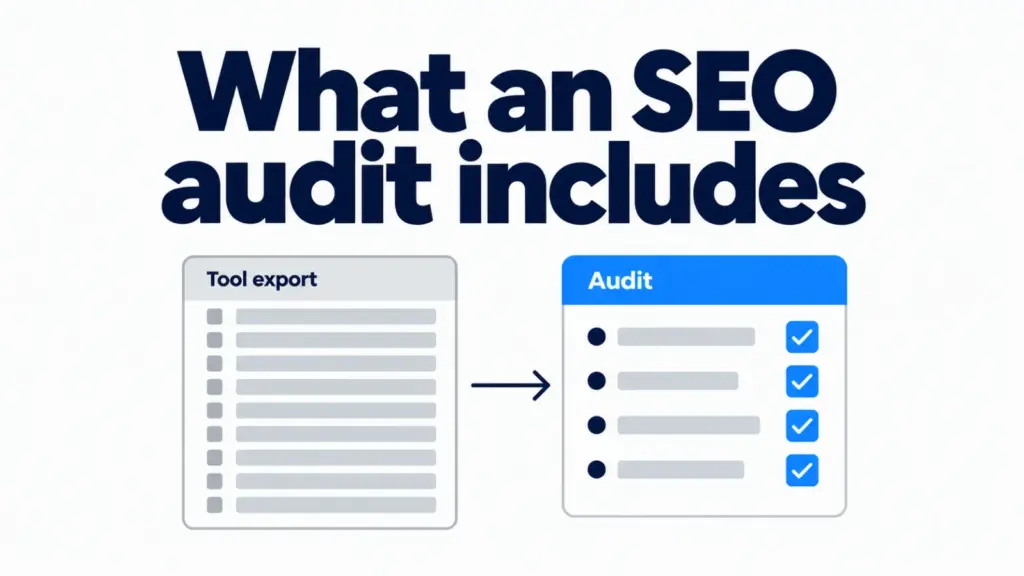
An SEO audit should hand you three things. The first is findings tied to specific pages. The second is an order to fix them in. The third is an estimate of the improvement to expect and the work it will take. Google’s guidance on hiring an SEO says an audit should give you realistic estimates of both. A list of crawler warnings with a company logo on top gives you none of the three, and it can cost as much as the real thing.
What the report should contain
A useful audit report has six parts, and each one is easy to check for. The table sets out what each part shows and what its absence looks like.
| Part | What it shows | Sign that it is missing |
|---|---|---|
| Findings by page | Each issue with the addresses it affects | Issue types and counts, with no addresses |
| Evidence | Which findings were measured and which are the auditor’s judgement | Every finding stated with the same certainty |
| Priority | Each finding ranked by likely effect and effort to fix | Findings in the order a tool printed them |
| Estimate | The improvement expected, the reasoning, and the work to get it | A promised ranking or traffic figure |
| Owner | Who makes each change: your team, your developer or the agency | Recommendations with nobody named |
| Scope | What was looked at, what was skipped and the date of the crawl | A report that never says what it left out |
Length tells you little. A report on the twenty pages that bring in enquiries serves you better than an export of every address on the site.
The estimate is where an audit most often goes wrong. Nobody can promise a position in the results, and Google says that an SEO who guarantees first place is one to walk away from. The estimate you want is a range with its reasons, such as the pages that are not being found today and how long the fixes take to make.
Which kind of audit you are being quoted for
“SEO audit” names at least four different jobs, and a quote that does not say which is hard to compare with another.
| Kind | What it examines | Ask to see |
|---|---|---|
| Technical | Whether search engines can reach, read and index the pages: structure, redirects, speed, the mobile version | The pages that are not indexed and why |
| Content and on-page | Titles, headings and whether each page answers the search it is meant for | The pages that compete with each other for one search |
| Links | The sites that link to you, and any links that look bought or spammy | The list of linking sites, with the ones that concern the auditor marked |
| AI visibility | How AI assistants describe the business and which sources they draw on | The questions tested, and the answers recorded for each |
The agency pages read for this directory show how far the word stretches. One lists five areas in its report: page titles and tags, site architecture, content, the links pointing at the site and page speed. A second lists architecture, titles and headings, loading time, the mobile version and technical items such as canonical tags and robots rules. A third sells a separate audit of how ChatGPT, Perplexity and Gemini describe a brand, which is a different piece of work again. Get the scope in writing before you compare prices.
What a free audit is
A free audit is a first look, and on the pages read it is also the start of a sales conversation. Of the 40 agency profiles written for this directory by 12 October 2026, seven list SEO audits among their services, and five of the seven have a page about the audit itself. Three of those five offer it free.
The three free offers are three different things. One is an automated tool. You enter one address and one keyword, and its page says the report takes 15 seconds and arrives by email. No access to your site is needed. One is a “mini audit” that its page describes as a top-level overview used to tailor a proposal, with the full audit carried out inside the paid campaign. One is a report prepared by a specialist, whose request form asks for your monthly marketing budget and who manages your marketing today.
The other two are not offered free. One is quoted on request and promises a detailed report of every fault with the steps to fix it. One is the AI visibility audit above, with a five-step method. None of the five pages prints a price for a paid audit or says how long one takes. That count covers only the pages read, and says nothing about other agencies.
A free audit is still worth having. Treat it as a sample of how the agency thinks, hold it to the six parts above, and expect the detailed findings to sit behind a proposal.
Why a tool’s warning list needs checking
A crawl finds what is on a page and cannot know why it is there. Google says it does not evaluate or endorse third-party SEO tools and that they have no access to its internal ranking data. Its advice is to check an audit’s recommendations against its own documentation before making significant changes to your site.
A worked example
The figures here are illustrative. A report flags 300 addresses as “not indexed”, meaning Google has not added them to its search results. Google’s Page indexing report says a page can be left out for good reasons. It lists a robots.txt rule, a noindex tag, a duplicate address and a page removed with no replacement. It also names filtered variations of a page as addresses that should stay out.
Say 280 of the 300 are filtered category pages. Those are the site working as intended. The twenty that matter are service or product pages that should be found and are not. A real audit sorts the two groups and says which one each address belongs to. A tool export merges them into one red number.
Written properly, that finding reads like this. Twenty service pages are not indexed, and here are the addresses. Google’s report gives the reason for each. The fix is to remove a stray noindex tag from the page template. Your developer makes the change in an hour. The pages can then appear for the searches they were written for. Every part of the six is in it.
How to check a finding yourself
Pick three findings and ask for the addresses behind them. Then look each one up in Search Console, which is Google’s own free report on your site. The Page indexing report shows the reason Google gives, and the URL Inspection tool, which that report recommends for this, shows why one page is not indexed. If the auditor cannot show where a finding came from, treat it as unchecked.
What an audit costs and how long it takes
No price and no timetable can be given here, because none of the five agency audit pages prints either for a paid audit. What you can do is see what moves both, and ask for them in writing.
Four things set the price and the time. The first is the size of the site, counted in page templates more than in pages, since one fault in a template repeats on every page built from it. The second is how many of the four kinds above are included. The third is depth: every address crawled and a sample examined by hand, or every important page examined by hand. The fourth is whether making the changes is in the fee or quoted afterwards.
An audit is a bounded job with an end date, and a fixed price suits it. Ask for the price, the scope and the delivery date together, and ask whether the fee comes off a retainer if you sign one. One agency’s site describes a detailed audit as the work of the first month of a campaign, which is the other common arrangement. What a retainer should hold after that is in what an SEO retainer includes.
What access to give the auditor
Read-only access to Search Console is enough to start. Google’s guidance says to grant read access only when an SEO offers an audit, and no write access at that stage.
Search Console has three roles that matter here. An owner has full control and can add and remove users. A full user has view rights to all data and can take some actions. A restricted user has simple view rights on most data and receives only the messages that affect that user. Google’s page on owners, users and permissions has a table of what each role can do, so read it before you choose.
Only an owner can add or remove a user. Keep ownership with your own company and you can end the auditor’s access the day the report arrives.
What happens after the report
A report changes nothing until someone makes the fixes, so settle who that is before the audit starts. If your own developer will do the work, ask for findings written for a developer: the address, the template and the change.
Search Console then tells you whether a fix took. Its Page indexing report has a “Validate fix” step, and Google says validation typically takes up to about two weeks and can take much longer. Movement in visits comes later still, for the reasons set out in how long SEO takes to show results. Ask whether the fee includes a second look after the fixes are made.
Two moments justify a fresh audit. Google’s guidance calls a planned redesign a good time to bring in an SEO, the earlier the better, because a site move can lose pages that were being found.
The other is a fall in visits you cannot explain. Google’s guidance on traffic drops lists several causes, among them a technical fault, a change to its ranking systems, a spam problem and the season. An audit can find the first and the third. It cannot reverse the second or the fourth, and an honest auditor will say which one you have.
Questions to ask before you accept a quote
Put these to each agency in writing, and compare the answers side by side.
- Which kinds of audit does the price cover: technical, content, links, AI visibility?
- Can I see a sample report with a past client’s details removed?
- Which findings come from a crawl, which from Search Console data and which from your own review?
- How many pages will you examine by hand, and how are they chosen?
- Who makes the changes the audit recommends, and is that work in the fee?
- When will the report arrive, and is a second look after the fixes included?
- What will you tell me if the audit finds little to fix?
The last answer shows whether the audit is a diagnosis or the first step of a sales process.
Ask for the sample report first
Before you compare prices, ask each agency for a sample report. Read it against the six parts above, and pick three findings to trace. A report that passes both is worth a fee. One that fails is a crawl export, and a crawl export is something you can run yourself.
To compare how agencies describe their SEO work, see the SEO agencies listed here and the UK SEO agencies.