
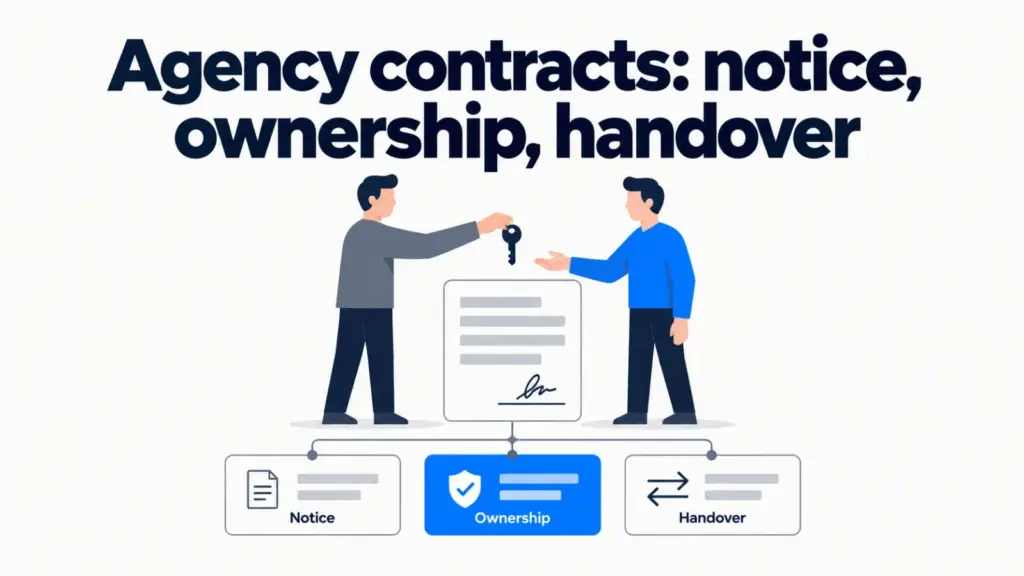
An agency contract settles its own ending on the day you sign it. Four clauses decide what leaving costs: how long you’re bound, what you pay until then, who owns the accounts and the work, and what the agency must hand over. Read them together before you sign. They’re the clauses you’ll rely on when the work has stopped performing.
Terms vary by contract, by service and by country. This guide shows where to look and what to ask. It can’t tell you what your own contract means.
The short version
- A 12-month term that renews unless you give 30 days’ notice has one exit date a year. Put it in your calendar on the day you sign.
- Of the 40 agency websites read for this directory in October 2026, four publish terms for client work. Where those set a notice period, it runs from one month to 90 days.
- In the United Kingdom and the United States, creative work made for you belongs to its creator unless a signed, written agreement says otherwise.
- Each of those four sets of terms keeps something you might assume is yours: the code, the intellectual property, the ad account or a domain.
- Get your own admin access to every account before you give notice.
How long are you bound?
You’re bound until the earliest date the contract lets you stop paying. Three clauses set that date: the minimum term, the renewal and the notice period. Read them as one clause.
| What to find | Why it matters |
|---|---|
| The minimum term | The shortest you can be held to |
| Whether it renews, and for how long | A term that renews for the same period adds another full term |
| The notice period | How long the fees continue after you ask to leave |
| When notice can be served | At any time, or only before a cut-off date |
| How notice must be sent | A notice sent to the wrong address may not count |
| What an early exit costs | The remaining months, a fee, or nothing |
A renewal clause, read with dates
The same decision on the same day ends three contracts on three different dates. The figures are an example, not a market rate. Say all three start on 1 April 2027, and you decide to leave on 10 March 2028. A rolling contract is one that continues month to month until someone gives notice.
| The clause says | Notice sent on 10 March 2028 | You stop paying after |
|---|---|---|
| Rolling monthly, 30 days’ notice | Counts from that day | 9 April 2028 |
| Rolling monthly, 90 days’ notice | Counts from that day | 8 June 2028 |
| 12-month term, renewing for 12 more unless notice is given at least 30 days before it ends | Nine days late: the cut-off was 1 March 2028 | 31 March 2029 |
Say the fee is $5,000 a month. The third contract then costs almost $60,000 more than the first. Contracts count days differently, so ask the agency to confirm the cut-off date in writing.
A minimum term has its own trap. A 12-month minimum with 30 days’ notice binds you for 13 months if notice can only be served once the minimum has ended. Ask whether notice can be served during the term, to end on its last day.
Break clauses
A break clause lets you end a fixed term early, on a stated date or with stated notice. One agency’s site describes its website packages this way: a 12-month contract, then a rolling one with a two-month break clause. Ask four things about any break. When can it be used? How much notice does it need? Is a fee due? Is it lost if an invoice is unpaid?
What notice is fair?
No official body sets a notice period for agency work, and the published terms we read don’t agree on one. Notice pays for two things: finishing work in progress and handing over. Judge it by how long those take for the work you’re buying.
Paid advertising is handed over by changing who has access to an account. Search engine optimisation (SEO) and content work carry drafts, commissioned articles and outreach under way. A website build is a project, so ask web design agencies for the payment stages and what you receive at each. Hosting needs long enough to move the site.
A notice period longer than the handover takes is a price. Ask what it buys.
Ask what an early exit costs. One agency’s published terms charge the monthly minimum for every month left in a committed term, and count pausing the work or moving it in-house as an early exit.
Check, too, whether you can leave early when the agency misses agreed work. That depends on how the scope is written, which what an SEO retainer should include covers for one service.
What do agencies publish about their terms?
Few agencies publish the contract. We fetched the home page of all 40 agency websites behind this directory’s profiles in October 2026. Eighteen link a terms page from it, and 15 of those could be read as text. Eleven cover only the use of the website. Four set out terms for client work.
Six of the 40 state a term, a notice period or a cancellation rule on a page we read. A seventh says only that it has no long contracts. The rules run from “cancel anytime”, with up to 15 days to take effect, to 90 days’ written notice on a rolling arrangement. One recommends a six-month minimum.
Two findings show why the wording for your own service matters. One agency sets a one-year initial term for SEO in its terms, while its paid ads page says the contract is rolling with no lock-in. Another gives a three-month minimum for pay-per-click (PPC) work in one clause and a fixed six-month minimum in another, where it creates the ad account.
Three of the four sets of client terms continue by default: two renew automatically and one runs from year to year. What they say on ownership, refunds and liability is in the sections below. Four agencies are not the market. Prices are published a little more often, as what digital marketing agencies publish about price shows.
Who owns what you’ve paid for?
Paying for something doesn’t make it yours. Ownership depends on the thing and on the country, so list what the work will produce and find the clause for each item.
Creative work, copy and code
The creator owns it unless a written agreement says otherwise. UK government guidance says that when you commission a work, the first owner of copyright is whoever created it, unless you agree otherwise in writing. A court may find an implied licence to use the work for the purpose it was commissioned for. That is a right to use, and it may be limited.
To own the work, you need an assignment. Government guidance on selling copyright says a transfer needs a written, signed contract.
United States law reaches the same place by another route. The Copyright Act’s definition of a work made for hire covers an employee’s work, and a commissioned work only in nine listed categories and only with a signed written agreement. Outside those cases the creator is the author. A transfer of ownership is valid only in writing and signed by the owner.
Published terms show what agencies write. One keeps all intellectual property in its work and grants the client a perpetual licence, though a website it builds becomes the client’s once paid for in full. Two keep the code: one licenses it for that project only, and one keeps bespoke code unless a fee is agreed in writing. In three of the four, what passes to the client passes only on full payment.
So ask for an assignment in writing, or a licence that names what you may do with the work and for how long. Ask for editable source files by name. One set of terms says the agency isn’t required to keep or supply them.
Ad, analytics and search accounts
An account belongs to whoever holds its top role, so that should be someone at your company. One agency’s published terms say the agency is the sole owner of any ad account it creates, with all the data in it. Under a clause like that, your campaign history stays behind when you leave.
Check each account today. The third column is what the platform’s developer documentation says.
| Account | What to check | What the documentation says |
|---|---|---|
| Google Ads | Someone at your company holds the Admin role, and the agency is linked through its manager account, the kind used to run several clients’ accounts | The Admin role owns the account and controls who else is added. A manager’s link is requested by the manager and accepted or refused by the client account |
| Meta ad account | Which Business Manager owns it: yours or the agency’s | Once a business claims an ad account, it can only be managed in that Business Manager |
| Google Analytics | Your company holds the Administrator role on the account and each property | Roles are viewer, analyst, editor and administrator, set per account or per property |
| Google Tag Manager | Your company has admin access to the account and publish access to the container | Account access is none, user or admin. Container access runs from read to publish |
| Google Search Console | Your own sign-in is listed as an owner of the site | Levels are owner, full user and restricted user |
Google’s documentation describes how a manager account links to a client account: the manager invites, and the client account accepts. So you can create the account yourself and let the agency link to it. Put the same question to each of the PPC agencies on your shortlist: whose name will the account be in?
Meta’s documentation says most marketing companies won’t need to claim their clients’ ad accounts. They can request access instead.
Search Console is the one you can recover yourself. Google registers an owner when it finds that person’s verification token on the site or in its domain records. Whoever controls the domain can therefore add themselves.
This guide read no rules for LinkedIn, TikTok or other platforms. Ask the same question of each: who holds the top role?
Domains and hosting
A domain belongs to the registrant, the name on the record of the registrar it was bought through. That name should be your company’s. ICANN, the body that accredits domain registrars, says a registrant has the right to transfer a domain to another registrar. Only the registrant of record or the administrative contact can start a transfer. The registrar must supply the transfer code within five calendar days of a request. It can’t refuse a transfer because its transfer fee is unpaid.
Changing the registrant’s name, organisation or email can lock a domain against transfer for 60 days. ICANN’s advice is to finish a transfer before changing those details. Country domains such as .uk have their own registries and rules.
Two of the four published terms register domains for clients. One says the client is the legal owner. The other says the agency owns the domain and releases it on request, with a £25 plus VAT fee for each domain moved to another registrar.
Hosting has no official rule to cite, only the contract. One set of terms says a site built on the agency’s own platform can’t be moved and is lost if you leave. Another lets a client buy a copy of its website at termination for no more than $6,000. A third charges its day rate to move a site to another host. Ask which applies before the build starts.
Take control back before you give notice
Get access first and give notice second, because access is easiest to get while the relationship still works.
- List every account, domain, tool and file store the work touches.
- Check who holds the top role on each, using the table above.
- Ask in writing for your own admin access to each one.
- Copy what exists only in the agency’s accounts: reports, creative files and campaign settings.
- Read the notice clause for how and where notice must be sent.
- Send notice that way, and keep proof of the date.
- Leave the agency’s access in place until the contract says it ends.
Step 7 protects you. One agency’s published terms treat changing credentials or blocking its users as termination without notice, with the notice-period fees due at once. The same terms accept notice only by email to one named address.
Give access at the level the work needs. For an SEO audit, Google’s advice on hiring an SEO is to grant read access only to Search Console.
What is charged beyond the fee?
Extras are whatever the contract prices outside the monthly fee, and published terms show how specific they get. Two of the four include two rounds of website revisions and charge for more, one of them at £600 a day. One prices extra website edits at $49 for 30 minutes, rushed requests at $199 each and meetings beyond one a week at $199 an hour. One raises its fees each April in line with UK consumer price inflation, with 30 days’ written notice.
Find the same list in your contract before the first invoice.
Who pays the platforms, and what happens to unspent money?
The contract decides both, so ask whose card pays the ad platforms. When you pay the platform yourself, the spend sits in your own account. When the agency pays and invoices you, ask what it adds and what happens to money not yet spent.
One agency’s published terms add a 10% fee to ad costs it collects, and credit unspent ad budget to future services with no refund. Another says its charges are not refunded after termination, however the contract ends. The fee models themselves are set out in how PPC agencies charge.
What must be handed over?
The agency must hand over what the contract lists, so write the list into it. A handover schedule names each item, a date and any fee. For marketing work it covers:
- Admin access to every account on your list, in your company’s name
- Editable source files for design and video, by file type
- The website’s code, database and content, with the licences needed to run it
- A written record of tracking, campaign structure and naming
- Work in progress: drafts, commissioned content and scheduled campaigns
- Personal data returned or deleted, at your choice
- A date for each item, and the rate for any help after it
Work in progress needs its own line. Say whether unfinished drafts and paid-for content come to you, and whether campaigns keep running through the notice period.
Where handover isn’t specified, plan for an overlap between the old agency and the new one, and budget for it.
What happens to your data?
Personal data the agency holds for you should come back or be deleted when the contract ends, and in the UK the contract must say so. Where an agency handles personal data for you, such as an email list or customer records, UK law requires a written contract. You are the controller and the agency is the processor. The Information Commissioner’s Office (ICO) lists what the contract must include.
Three of its minimum terms matter here. The agency processes the data only on your documented instructions. It uses another processor only with your written authorisation. When the contract ends, it deletes or returns the data, at your choice. The ICO marks this guidance as under review after the Data (Use and Access) Act, so check the page’s current wording.
Rules in the United States differ by state. Where California’s privacy law applies, the state’s Attorney General says the business is responsible for answering consumers’ requests, and its service provider is treated differently. Whatever the law, ask what happens to your lists and customer data when you leave, and put the answer in the contract.
What do the liability and payment clauses say?
A liability clause limits what you can recover if the agency’s work causes you a loss. All four published sets of terms have one. Two cap the agency’s liability at the fees paid in the previous six or twelve months. The other two exclude lost profits, or any effect on the client’s business.
UK government guidance for businesses says a standard contract can’t exclude responsibility for death or injury. It can exclude losses caused by negligence only where that is reasonable. A court decides what is reasonable, and weighs whether the contract was negotiated and whether the buyer had the bargaining power to get better terms. The same guidance says a seller has more responsibilities towards consumers than towards other businesses, so don’t count on consumer rights.
Payment has a UK default too. Where no date is agreed, a payment is late 30 days after the invoice arrives, or after the service is delivered if that is later. Statutory interest on a late business payment is 8% plus the Bank of England base rate, unless the contract sets its own rate. One agency’s published terms add $25 a day to a late invoice.
These are UK rules. Elsewhere, the contract’s own clause and the law it names decide.
What if the agency won’t change its terms?
Put your changes in the document that is written for you: the proposal or order form. One agency’s published terms say the term in the signed proposal governs. So ask there for a shorter first term, a break date, or notice that can be served during the term.
Get promises into the contract itself. One set of published terms says the contract is the whole agreement, and that descriptions on the agency’s website form no part of it. Another says the agency may change its terms by posting a new version, with no notice. Keep a dated copy of any web page your contract refers to.
Ask for the standard terms when you send the brief, so you read them before the proposal arrives. How to write an agency brief covers the rest of that document.
If nothing moves, price the risk with the dates table above and decide whether the work is worth it. Then put these questions to the draft.
| If you read | Ask |
|---|---|
| A term with no stated end | Does it renew, for how long, and what date stops that? |
| “Reasonable notice” | How many days, counted from what date, sent to which address? |
| “We’ll set up your accounts” | Whose name will they be in, and who holds the Admin role? |
| No mention of source files or code | Do we receive them, and do we own them? |
| No handover clause | What will you transfer, by when, and at what cost? |
An agency’s answers are worth having in writing. If it declines to put them in the contract, you’ve learned something before the first invoice.
Open the contract and find four things
Today, open the contract you have or the draft you’ve been sent. Find the last day you can give notice, the address notice must go to, the clause on who owns the ad accounts, and the handover list. Put the first in your calendar. If any of the four is missing, ask for it before the next invoice.
If you’re still choosing, how to choose a digital marketing agency covers what to compare before a contract arrives. The other digital marketing guides sit beside it.
Contract law, copyright and data protection differ by country, and a contract can change any default described here.
This guide is general information, not legal advice. For a significant contract, have it reviewed by a lawyer.