
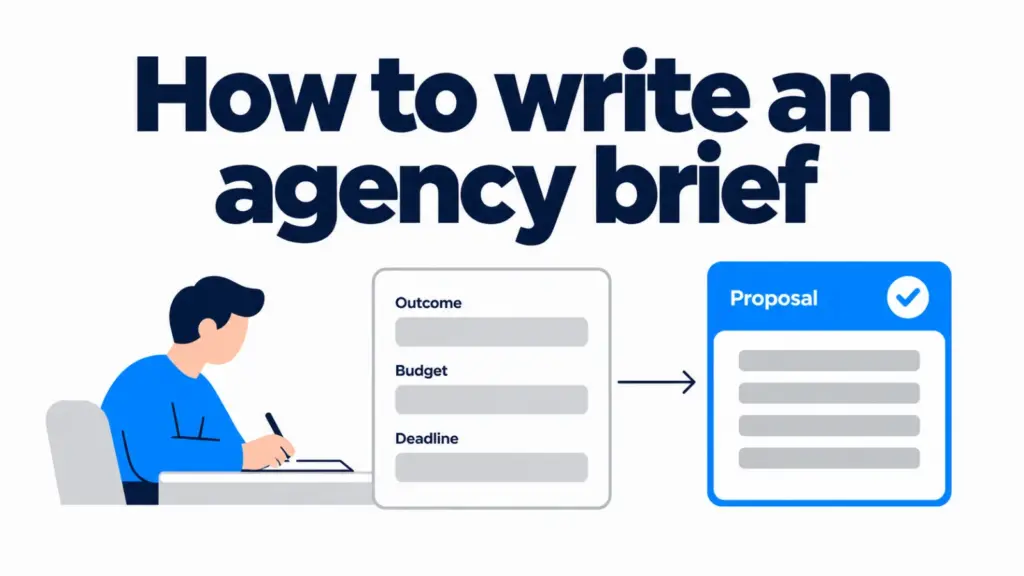
A brief that gets useful, comparable proposals states four things plainly: the outcome you need, the budget you have, the deadline that is real and the constraints you can’t change. It then asks every agency for the same answer, in the same form, by the same date. Agencies price against what you write, so every gap you leave becomes a difference between the proposals, and you end up comparing assumptions.
The short version
- Describe the result your business needs. “A site that lets trade customers reorder without calling us” lets an agency propose the right thing.
- State the budget with its unit: a total or a monthly figure, with ad spend inside it or on top.
- Put three dates in the brief: when questions close, when proposals are due and when you’ll decide.
- Send it to three to five agencies on the same day, and tell each how many others have it.
- Of 22 agency enquiry forms read in October 2026, four ask for a budget and eight offer only a message box. The brief is yours to bring.
Start with the outcome
An outcome is something that changes in your business. A deliverable is something an agency hands over. If the brief names only the deliverable, the agency can only quote for it, and you may not need it.
| Deliverable (what you asked for) | Outcome (what you need) |
|---|---|
| A new website | Trade customers can reorder without calling us |
| More SEO | More enquiries from the three cities we serve |
| A social media plan | A steady flow of applicants for our open roles |
| A rebrand | Buyers at larger firms take us seriously on first contact |
Write the outcome as a sentence with a figure and a date where you have them: “forty qualified enquiries a month by June”. If you don’t have a figure, say what you’d count as success and how you’d know.
State the budget, and what it covers
Give a number or a range. A hidden budget gets proposals built for the most expensive reading of your brief, or the cheapest. A range lets each agency show what it would do inside it.
Say what the figure covers. Is it a total for the project or a monthly retainer, a fixed fee for ongoing work? Does it include ad spend, or is that on top? Does it include any tools or licences? A $5,000 monthly budget could mean $5,000 of fees or $5,000 of fees and ad spend together, and agencies will answer different questions.
The unit matters because agencies don’t share one. Four of the 22 enquiry forms read for this guide ask for a budget, and no two ask the same way. One wants a project total in pounds, in bands from up to £10,000 to over £100,000. One starts its bands at £10K. One uses a slider that runs from AED 5K to AED 100K+. The fourth asks for your annual marketing budget, and its lowest named band is $5 to $10 million.
If you have no figure yet, what digital marketing agencies publish about price sets out the figures agencies print on their own sites.
Separate the real deadline
Mark the date that is fixed, such as a launch, a trade show or a contract renewal, and the date you would like. An agency plans differently around each. A fixed date may mean a smaller first release, and a preferred date allows a better one.
Say who must approve things before the date, and how long they take. Two weeks of approvals is a constraint on the schedule, and the agency can’t see it unless you write it down.
Name the constraints
Constraints are what the agency can’t change. List the platforms you are committed to, the systems the work must connect to, brand rules, legal review, and the markets or languages in scope.
Name the decision-maker. If a marketing manager runs the process and a finance director approves it, say so, and say what the finance director cares about. A proposal written for the wrong reader answers the wrong questions.
Add the context that changes the proposal
Four kinds of context change what an agency would propose.
- What has been tried before, and what happened.
- Whether an agency works for you now, and why you are looking.
- Who the customer is, in a few plain sentences.
- What data and accounts exist, and who holds them.
Leave out your company history, which an agency can read on your website, and a long list of everything you might want. A list of wants that runs to 40 lines has no order, so the agency has to guess.
What to add for each kind of work
The four things apply to every project. Each kind of work also depends on facts only you can supply.
| Kind of work | Add to the brief | Why a proposal needs it |
|---|---|---|
| SEO | The site’s platform, the countries and languages, who can change the site and how fast | Fixes you can’t make are not worth quoting |
| PPC (pay-per-click ads) | Current monthly spend, whether conversion tracking works, who owns the ad accounts | The agency can’t judge results without a baseline |
| Web design and development | The content you have, the systems to connect, who maintains the site afterwards | Content and integrations decide the size of the work |
| Branding | Where the brand shows up, who must approve it, what you would not change | Scope runs from a logo to every channel |
| Social media | The channels in use, who answers messages, what content you can supply | Posting is a fraction of the work |
Each row is a question the agency would otherwise ask on the first call. Answering it in the brief saves the call for the work.
Ask every agency for the same answer
Proposals line up side by side only when each agency was asked for the same things by the same date. Two parts of the brief do that: a list of what to send, and a timetable.
What to ask for
Six items cover a first selection:
- the outcome, restated in the agency’s own words
- what it would do, and in what order, in the first three months
- who would do the work, and how much of their time you get
- the price, split into fees, ad spend and third-party costs
- what it has assumed, and what it needs from you
- one piece of similar work, with the result and how it was measured
Set a page limit as well, and say that anything beyond it won’t be scored.
The three dates
A brief needs three dates: when questions close, when proposals are due and when you’ll decide. Without them each agency sets its own pace, and you can’t compare anything until the last proposal arrives.
Work back from your fixed date: decision, then proposals, then questions, then the day the brief goes out. Leave real time between the brief and the proposals.
When the time is too short, the agencies you most want either decline or send a thin proposal, because a careful answer takes people off paid work.
Write the scoring into the brief
Decide how you’ll score the proposals before you send the brief, and print the criteria in it. Agencies then answer what you’ll judge. You also commit yourself before the best-designed document arrives.
| What you score | Example weight | What a strong answer shows |
|---|---|---|
| Understanding of the outcome | 30 | The outcome restated with how it will be counted, and what the agency needs from you to reach it |
| The plan | 25 | Steps in order for the first three months, with what you’ll see at the end of each |
| Price against the budget | 20 | Fees, ad spend and third-party costs shown apart, inside the range you gave |
| The people | 15 | Who does the work, by role, and how much of their time you get each month |
| Fit with your constraints | 10 | Your platform, approvals and dates worked into the plan |
The weights are an example. Set your own, make them add up to 100, and have two people score each proposal separately before they compare notes.
A score covers the document. How to choose a digital marketing agency covers the rest: the questions for the first call and the reasons to stop a conversation.
A sample brief
The brief below is a made-up example for a fictional accountancy practice. Adapt the shape and replace every figure and date.
| Section | Sample text |
|---|---|
| Project | More enquiries for a regional accountancy practice |
| Outcome | Forty qualified enquiries a month from three cities by the end of June. A qualified enquiry is a call or form that names a service we offer. |
| Budget | $4,000 to $6,000 a month in fees. Ad spend is separate, at about $3,000 a month. |
| Dates | Fixed: the partners meet on 15 January and approve any redesign that day. Preferred: work starts in the first week of January, with first results to review by the end of April. |
| Constraints | The site runs on a common site builder, and changes go through one contractor who needs two weeks’ notice. No claims about guaranteed outcomes: our regulator is strict about them. |
| Context | Paid search ran for six months last year and was stopped because tracking was unreliable. The ad accounts are in our name. No agency works for us now. |
| Who decides | The marketing manager runs the selection. The finance partner signs off, and cares most about cost per qualified enquiry. |
| What to send | Eight pages at most: the outcome in your words, your plan for the first three months, who does the work, the price split into fees and other costs, your assumptions, and one similar project. |
| Timetable | Questions by 9 November, answered to everyone by 11 November. Proposals by 23 November. Decision by 7 December. Four agencies have this brief. |
| How we’ll choose | Understanding of the outcome 30, plan 25, price against budget 20, the people 15, fit with our constraints 10. Two of us score each proposal. |
How long a brief should be
One to two pages is enough for most projects. The sample above runs to about 260 words and fits on one page, and every line changes what an agency would quote.
A longer brief isn’t a clearer one. If the detail runs on, such as a list of systems, a content inventory or brand rules, attach it and keep the brief short.
Who signs it off before it goes out
Three people should read the brief before any agency does. One holds the budget, one makes the final decision, and one controls the website, the ad accounts or the data. Any of them can change the brief later. A brief that changes after the proposals arrive turns them into answers to a question you’ve stopped asking.
Ask each for one thing. The budget holder confirms the figure and what it covers. The decision-maker confirms the outcome and the scoring. The technical owner confirms the constraints: what can be changed, by whom and how fast.
Get each approval in writing. A one-line email is enough, and it means the figure in the brief is a figure you can sign for.
How many agencies to send it to
Send the brief to three to five agencies, all on the same day. Fewer than three gives you too little to compare. Every agency past five adds a set of questions to answer and a proposal to score, and a small team stops reading each one properly.
Tell each agency how many others have the brief. You don’t need to name them. A stated number lets an agency decide honestly whether to answer, and an agency that declines early has saved you a weak proposal. If an agency already works for you and is being asked to pitch again, say that too.
To build the list, start from a service page such as SEO agencies and filter by minimum budget, industry and team size. A place page, such as the agencies in the United Kingdom, suits work that needs someone nearby.
What an agency’s own form asks first
An agency’s enquiry form asks for less than a proposal needs. The counts below come from 22 forms on the sites of agencies listed in this directory, read in October 2026.
| What the form asks for | Forms, of 22 |
|---|---|
| A budget | 4 |
| A timeline | 1 |
| What you want to achieve | 4 |
| A service or type of project, picked from a list | 6 |
| How many people your company employs | 1 |
| How you heard of the agency | 3 |
| Your website address | 5 |
| An upload for a brief or a request for proposal (RFP) | 2 |
| Contact details and an open message, and nothing else | 8 |
A form with an open message box is asking you to bring the brief. Paste the outcome, the budget and the three dates into the message, and attach the full brief where there is an upload field.
Read a form’s budget bands before you pick one. If your figure sits below the lowest band, ask whether the agency takes work of your size before you send anything longer.
When agencies send questions back
Answer every question, and send each answer to every agency. If one agency learns your real deadline on a call and the others don’t, its proposal rests on facts the rest never saw. Leave the asker’s name off each question when you circulate the answers.
Close questions a few days before proposals are due, and reply in one document.
Offer each agency the same short call as well. The Institute of Practitioners in Advertising (IPA) is a UK body whose members are agencies. Its page for the Briefing an Agency best practice guide says a written brief is important and isn’t enough by itself. It gives the briefing meeting a role of its own.
Keep a note of who asked what. An agency that asks how you count an enquiry, or who can change the site, has read the brief, and that is evidence for your first scoring line.
What to leave out of a brief
Four things don’t belong in a document that goes to several companies, all but one of which you won’t hire.
Anything that needs a confidentiality agreement
Give margins, customer lists and unreleased plans as ranges, or leave them out. Share the detail with the agency you choose, once an agreement is signed.
Logins and account access
No agency needs a password to write a proposal. If a baseline matters, export the figures or offer read-only access, and keep every account in your name.
The solution
“We need a WordPress site” rules out an agency that would have proposed something cheaper. Name a platform only when it is a constraint you can’t change.
A request for finished work, free
A proposal shows how an agency would approach the job. Asking for the campaign itself, or a full strategy, is asking for the job unpaid. The IPA and the advertisers’ body ISBA launched the Pitch Positive Pledge in 2022. Under it, the advertiser commits to consider the implications of what it asks agencies to do during a pitch.
Posting the brief on this directory
The marketplace brief form takes the same brief in fields, and it is free to post. It asks for a project title, a description of at least 200 characters, a timeline and a budget. The budget is one of six bands, from under $5,000 to $100,000 and over, marked as a total or a monthly retainer. It also asks which services you need, where you’d like the agency to be and, optionally, your industry.
Tick at least one service
Matching starts from the services you tick, and a brief with none ticked is matched to no agency. The brief goes to agencies listed for at least one of those services. A region or an industry, where you pick one, narrows the list further, so pick an industry only when sector experience is a requirement.
Put the budget’s unit in the description
The email a matched agency receives shows the project title, the budget band and the timeline. Whether the band is a total or a monthly figure isn’t in it. Say so in the description, with what the figure covers.
Keep your name out of the description
Agencies never see the name, company, email or phone you enter in the contact fields. The description is different. Member agencies on the Gold plan or above read it in full. A published brief’s title and the first 40 words of its description also appear on a public projects page, with its services, budget band and timeline. Leave your company’s name and your own out of both.
Send it to your own shortlist too
Treat the form as an extra route, and your own shortlist as the main one. You confirm your email, a person at the directory reads the brief, and then it is published. Only member agencies on the Gold plan or above can send a proposal through it, so an agency on a lower plan can’t answer this way however well it fits.
A proposal that is sent arrives by email with the agency’s name, a link to its profile and an address to reply to, and you decide whom to answer.
Send the brief yourself to every agency on your shortlist. That is the only route that reaches all of them.
When the proposals arrive
Score each proposal against the criteria you printed in the brief, with the second scorer working separately. Then tell every agency the outcome yourself, including the ones you didn’t choose, and say why. The same pledge commits an advertiser to exactly that: to inform each agency directly, win or lose, and to give feedback.
Before you sign with the winner, read the guide to notice periods, ownership and handover. The brief you wrote becomes the scope the contract is priced against, so keep the version you sent.