
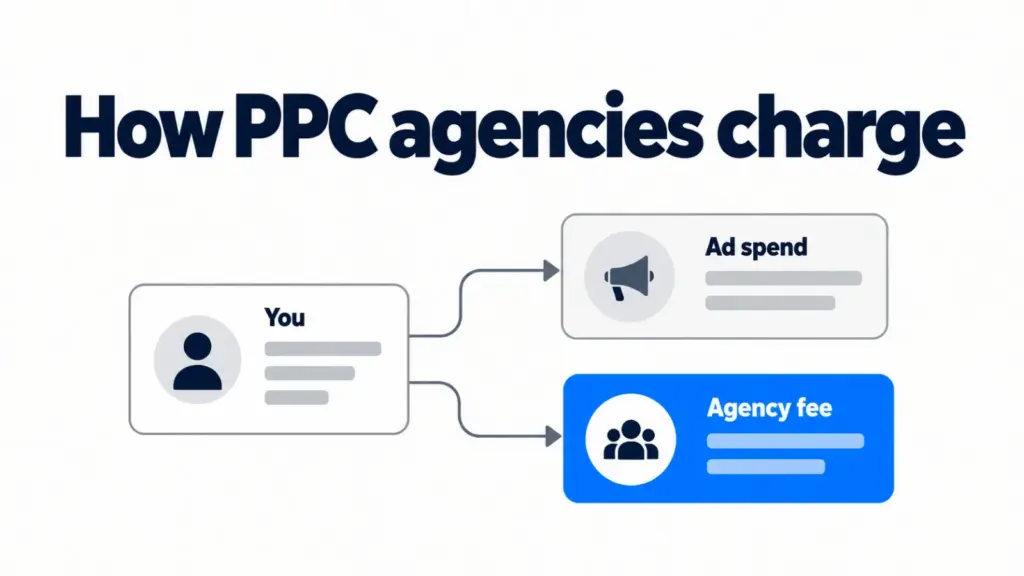
A pay-per-click (PPC) agency charges for managing your ads in one of four ways. It takes a flat monthly fee, a percentage of your ad spend, a mix of the two, or a price for each lead or sale. The ad spend is a second cost, paid to the ad platform. Before you compare two quotes, find out how each fee is worked out and who pays the platform.
Two bills: the ad platform’s and the agency’s
Ad spend is what the platform charges when people click your ads. The agency’s fee pays for planning, building and adjusting the campaigns. Ask for the two as separate lines.
Then ask who pays the platform. In Google Ads the account’s billing setup decides it. Google’s billing setup documentation says the setup links the account to a payments account and determines who is billed for costs. Several accounts can be grouped on one invoice, so an agency can pay for many clients and bill each one afterwards.
Agency websites describe both arrangements. One says you pay the platforms directly and its own fee is billed separately. One set of published terms adds a 10% fee to any ad cost the agency collects, and credits unspent budget to future services with no refund.
Four fee models, and what each does when your budget moves
The four models differ most in what happens to the fee when your ad budget changes.
| Model | How the fee is set | If you halve the ad budget |
|---|---|---|
| Flat monthly fee | A fixed amount for an agreed scope | The fee stays, and becomes a larger share of the total |
| Percentage of ad spend | A share of what you spend on ads | The fee halves, unless a minimum applies |
| Flat fee plus a percentage | A base fee, then a share above a spend level | It falls only as far as the base |
| Price per lead or sale | An amount for each result counted | It follows the count, so the definition of a result sets the bill |
What 40 agency websites say about the fee
Five of the 40 agency websites read for this directory in October 2026 say how the fee for managing ads is worked out. Two charge a percentage of ad spend. One of those sets a minimum of 1,200 dollars and no set-up fee. The other says its percentage varies with spend, complexity and the level of service.
Two charge a monthly fee. One calls it fixed and separate from ad spend, and prints no figure. The other prints management from $475 a month for each channel, plus your click budget. The fifth says, in a 2023 post still on its site, that clients pay only for the leads and conversions it delivers.
None of the five prints its percentage, and none describes a base fee plus a share. Two more sites say only that the fee depends on the size or complexity of the campaigns. Set-up is handled three ways: no set-up fee, a 30-day set-up included in the fee, and a one-time fee written into the terms.
These are 40 websites and no more than that. What they print about price in general is in what digital marketing agencies publish about price.
One budget cut under three fees
Halve the ad budget and three fees behave in three ways. Say you spend $6,000 a month on ads, then cut to $3,000 for a quarter. A flat fee of $1,000 stays at $1,000. A 15% fee falls from $900 to $450. A 15% fee with a $750 minimum falls only to $750, which is 25% of what you now spend. These figures are an example and aren’t market rates.
A percentage pays the agency more when you spend more, whether or not the work grows. A flat fee doesn’t move with spend, so ask what work it covers at each budget.
What to settle before you compare quotes
Put five questions to each agency in writing.
- Is the percentage taken from spend on one platform, or on all of them?
- Is there a minimum fee, a set-up fee or a minimum term?
- Who pays the platform, and is anything added to its charges?
- Whose name is the ad account in?
- If the price depends on leads, what counts as a lead?
The last answer sets the bill. How to read a PPC agency’s monthly report shows how conversions are counted. Notice periods and account ownership are in the guide to agency contracts, ownership and handover.
Then send the same five to the PPC Marketing agencies on your shortlist, or to PPC agencies in the United Kingdom.