
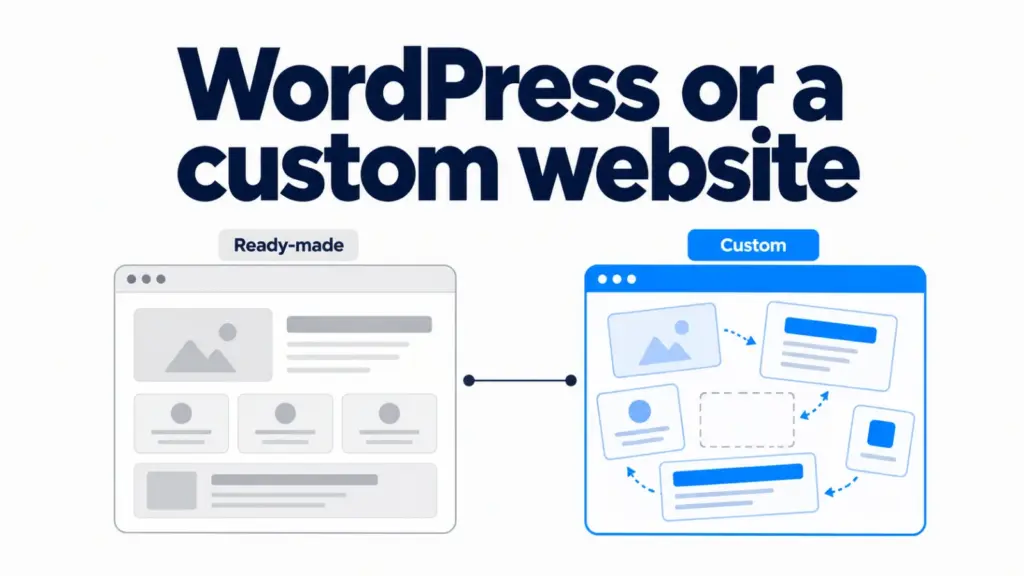
Use WordPress when the site is mostly pages that your own team will edit. Choose a custom build when the site is really an application, with logins, quoting or integrations that no platform handles well. WordPress is free, open-source software, so you pay for people, hosting and upkeep. Check what an agency means by custom: on six agency websites read, the word describes a site built on WordPress or Shopify.
What each one is
WordPress is software you install on hosting you pay for. WordPress’s own site says it is open source, built on PHP and licensed under the GPL, which lets anyone run, change and share it. A theme controls the design. A plugin is a package of code that adds a function, and its directory lists over 75,000 free ones.
A custom build is written for your requirements in a framework the developers choose. Nothing comes ready-made, so each feature is built, tested and maintained by whoever you pay.
Between the two sits a custom theme on WordPress. The design and templates are made for you, and the editing screens and updates come from the platform. A hosted shop platform is a third route: Shopify’s site says its monthly subscription includes hosting, security and updates.
WordPress is also the most widely used system of its kind. W3Techs, which surveys over 20 million websites, found it on 40.1% of them on 12 October 2026, against 5.4% for Shopify. That matters for one reason: more agencies can take a WordPress site over.
A decision table
| If the site is | Lean towards | Because |
|---|---|---|
| Pages, news and forms your team edits | WordPress or a similar platform | The editing tools already exist |
| The same, with a design made for you | A custom theme on a platform | The design is yours and the upkeep is standard |
| A shop with a standard catalogue | A shop platform, or WordPress with a shop plugin | Checkout and stock are solved problems |
| A portal with logins and records per customer | Custom, or a specialist platform | The logic is yours alone |
| Tied to stock, pricing or other internal systems | Often custom | Integrations are where a platform strains |
The table is reasoning, so ask each agency to say where your project sits and why.
Who keeps it running
Someone has to update the site for as long as it is live, so settle who before you sign. WordPress.org says only the latest version of WordPress is officially supported. It recommends hosting that runs PHP 8.3 or later, and it warns against themes and plugins from untrusted sources. Every plugin is someone else’s code with its own updates.
A custom build carries the same duty with fewer people able to do it, because only developers who know that code can patch it. Ask what upkeep costs a month on either route.
What 32 agency websites build on
Of the 40 agency websites read for this directory in October 2026, 32 offer website or web application builds. Of those, 23 name a platform, and 18 of the 23 name WordPress. Nine name Shopify, four name Magento or Adobe Commerce and four name Drupal. Eleven name one platform only and 12 name several. The other nine build custom software, use a platform of their own or name none.
Agencies argue for what they sell. One says it is exclusively WordPress and lists the platforms it won’t support. One says it doesn’t build from a ready-made platform at all. One page says a custom shop makes the code your asset, where Shopify or WooCommerce leaves you on third-party code. Another says Shopify is quicker to build on than WordPress or Magento, which it calls more expensive to set up.
Each is a seller’s view. Ask what the agency does when your project doesn’t fit its platform.
What to ask either way
Ask four things before you choose. Who maintains the site after launch, and what does that cost a month? How are updates and security fixes handled? How will your team edit pages without a developer? Who owns the code and design files, and can you move the site to another host or agency?
On the last, WordPress’s licence page says themes and plugins built on it inherit its open licence, and it notes a legal grey area. Ask what the contract means by ownership. The guide to agency contracts covers ownership and handover. The website prices that agency sites print are in what digital marketing agencies publish about price.
To compare how agencies describe their build work, see the web development agencies listed here and the UK web development agencies.