
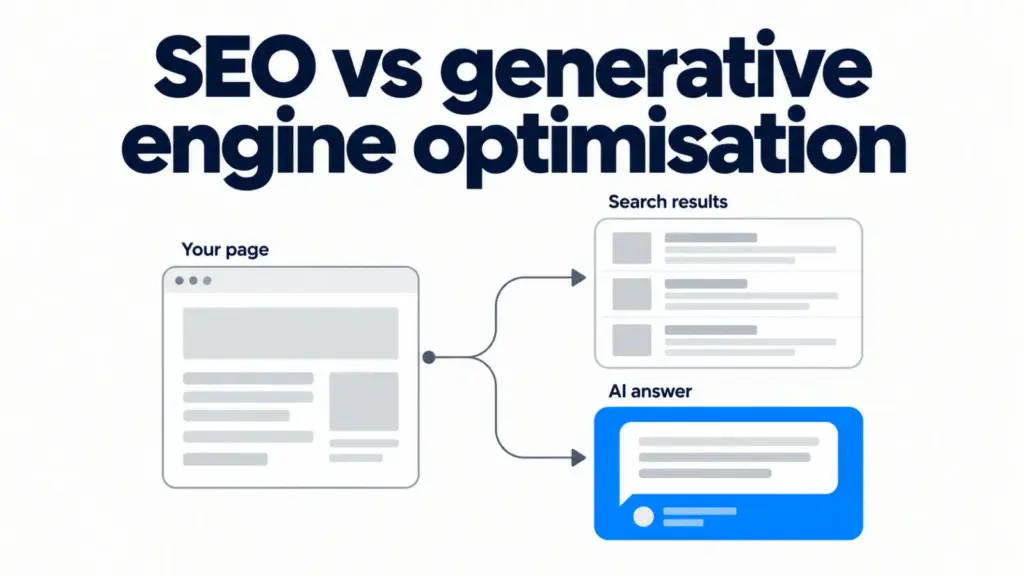
Most of what is sold as generative engine optimisation (GEO) is SEO, and Google says so in its own guide. Two things are new as of October 2026. Each AI product reads your site with its own crawlers, which you can allow or block one by one. And two search engines now report how often your pages appear in their AI answers. Whether an answer names your brand is something no agency controls.
What Google says about GEO
Google treats GEO as SEO. GEO means getting a brand named or cited when someone asks an AI assistant a question, and some agencies call it answer engine optimisation (AEO). Google’s guide to generative AI search, updated in July 2026, says optimising for AI answers is optimising for search, “and thus still SEO”.
A page has to be indexed and eligible to show a snippet, as for any search result. The guide then lists five things you can ignore for Google Search.
- an
llms.txtfile, a text file meant to describe a site to AI systems - splitting pages into small “chunks” for AI
- rewriting content in a special style for AI
- seeking mentions on other sites that are not genuine
- special structured data, the labels in a page’s code that describe its content
Structured data is still worth having for ordinary search features, the guide says, and an llms.txt file neither helps nor harms. Read Google’s generative AI guide before any proposal. It speaks for Google Search only. It says nothing about ChatGPT, Perplexity or Claude.
Which crawler to allow for which product
The AI companies document crawlers for up to three jobs, and blocking each kind costs something different. A crawler is a program that reads your pages. Your robots.txt file tells each one what it may read. These are the names each company documents, as of October 2026.
| Company | Finds pages for its search answers | Collects training data | Fetches a page when a user asks |
|---|---|---|---|
| Googlebot | Google-Extended | Not covered on the pages read | |
| OpenAI | OAI-SearchBot | GPTBot | ChatGPT-User |
| Perplexity | PerplexityBot | None documented | Perplexity-User |
| Anthropic | Claude-SearchBot | ClaudeBot | Claude-User |
Microsoft’s posts read for this piece name no separate crawler for Copilot. They say Bing respects robots.txt.
Blocking a search crawler takes you out of that product’s answers
OpenAI says a site that opts out of OAI-SearchBot won’t be shown in ChatGPT search answers, though it can still appear as a plain link. Anthropic says blocking Claude-SearchBot may reduce a site’s visibility in the search results it gives users. Googlebot is the one control for Google Search, with AI Overviews and AI Mode inside it. OpenAI’s crawler overview gives the exact names to look for.
Blocking a training crawler is a separate decision
OpenAI says each setting is independent, so you can allow OAI-SearchBot and disallow GPTBot. Google-Extended is a name used in robots.txt, with no crawler of its own. Google says it has no effect on inclusion or ranking in Search. It decides whether your content may train Gemini models and support answers in the Gemini app. That choice is yours to make, and an agency should ask you before changing it.
Fetchers that act for a user may not follow the file
ChatGPT-User and Perplexity-User fetch a page when a person asks for it. OpenAI says robots.txt rules may not apply to ChatGPT-User, and Perplexity says its fetcher generally ignores them. Anthropic says its bots follow robots.txt, and that blocking Claude-User stops Claude retrieving your pages for a user.
The firewall can block what the file allows
A firewall, or the delivery network that sits in front of your site, can turn a crawler away whatever robots.txt says. OpenAI and Perplexity publish the addresses their crawlers use so a site can let them through. Changes to robots.txt take about 24 hours to register at OpenAI and up to 24 hours at Perplexity.
What can be measured in October 2026
Two reports now come from the search engines themselves. For every other AI product, measurement is still a sample.
Google Search Console, Google’s free reporting tool for site owners, has carried generative AI performance reports for all sites since 31 August 2026. They show impressions: how often your pages appeared in AI Overviews, AI Mode and the AI features of Discover. You can split them by page, country, device and date. Google’s announcement of the reports names no click counts and no list of the questions people asked.
Bing Webmaster Tools has an AI Performance report in preview. It counts citations, the times a page was shown as a source, across Microsoft Copilot, Bing’s AI summaries and partner products. Microsoft says the counts don’t show where a page sat within an answer, and its citation share figure names no competitor.
For ChatGPT, Perplexity and Claude, the crawler pages read for this piece describe no report for site owners. What’s left is sampling: a fixed list of questions, asked several times on stated dates, with every answer recorded. Tracking software automates the asking. Google’s guide warns that no third-party tool has access to its ranking or AI systems.
What isn’t known
No AI company, on the pages read, publishes the rules by which it picks the sources it cites. Google says only that its AI features rest on its Search ranking systems. Microsoft says citation patterns shift as models, freshness and user behaviour change. The 2023 research paper that named GEO says in its abstract that its tactics worked differently from one subject area to another. So nobody outside these companies can tell you the chance of being cited. A promised citation is a promise about someone else’s system.
What 19 agencies sell under the name
The same name covers very different offers. Of the 40 agency websites profiled for this directory by October 2026, 19 name AI search work as a service. Each one’s page on it was read again that month.
| What the agency’s page states | Agencies, of 19 |
|---|---|
| Calls the service GEO (the rest use AEO or AI search) | 16 |
| Says it builds on SEO or runs alongside it | 12 |
| Starts with an audit of the brand’s presence in AI answers | 13 |
| Names a measure of presence in AI answers | 15 |
| Says how many questions it tracks | 3 |
| Prints a price | 2 |
| Shows a named client’s result | 4 |
| Offers a written guarantee | 1 |
Sells an llms.txt file | 2 |
Six labels appear across the 19: GEO, AEO, AI search, AI SEO, LLM SEO and AIO. The three that count their questions range from 10 per AI product to about 300. One of the two prices covers SEO and GEO together, from £750 a month plus VAT. The other sells packages sized by AI products and questions.
The guarantee is offered to a business that passes the agency’s own readiness assessment: rank in AI search within an agreed time, or the next three months are free. One other agency tells buyers to distrust anyone who guarantees a citation overnight. Eight give a timescale, and they run from days for a single question to 11 months in one published case. Where an audit comes first, test it the way you would tell an SEO audit from a tool export.
Old work under a new name, and work that is new
Most lines on a GEO proposal are SEO lines, and a few are new. If you already pay one of the SEO agencies for a retainer, ask which lines are additional to it.
| On the proposal | What it is | How to check it |
|---|---|---|
| Structured data, clearer pages, technical fixes | SEO you may already pay for | Compare it with your current scope |
| Digital PR, “citation building”, brand mentions | SEO’s link and mention work | Ask for the named sites and the reason for each |
| Crawler and firewall review | New, and small | A written status for each crawler in the table above |
An llms.txt file | New, and ignored by Google Search | Ask which product reads it and where that is documented |
| Question tracking | New measurement | The questions, the products, the repeats and the dates |
| The Google and Bing AI reports | New reports in tools you own | Access in your name |
What to write into the scope
A GEO scope can be tested when it lists six things.
- The questions tracked, the AI products asked, the number of repeats, and a baseline run dated before any change.
- Each crawler’s status in
robots.txtand at the firewall, with your decision on training crawlers recorded. - Exports of the Google and Bing AI reports for the period before the work.
- The pages to be changed, and the change to each.
- A monthly report: the same questions by the same method, both first-party reports, and visits from AI assistants in your own analytics.
- Search Console, Bing Webmaster Tools and analytics accounts held in your name, as the guide to agency contracts and ownership sets out.
Accept the work when those six are delivered. Don’t make a citation the test, because the agency doesn’t control the answer.
What a fair first month hands you
A fair first month hands you three documents and no claimed result: the baseline run, the crawler status list and the report exports. You can start two of them today. Open your robots.txt by adding /robots.txt to your address, and look for the names in the table. Then open Search Console and find the generative AI report. If you’re comparing agencies, ask each of the UK SEO agencies on your list for a sample baseline before a price.