
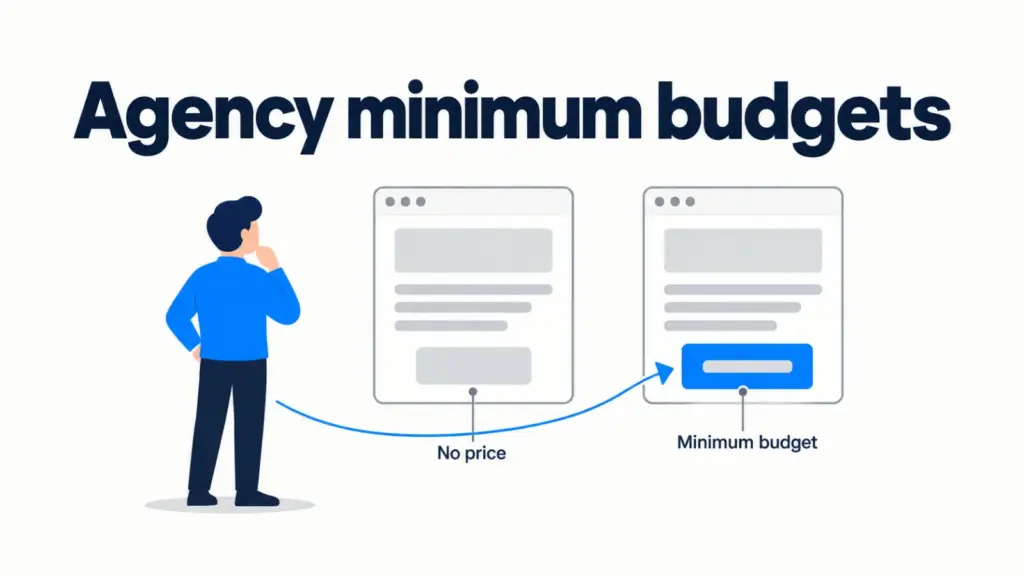
Publish a minimum, in the form a buyer can act on: a figure, its unit and what it buys. Of 40 agency websites read in October 2026, 14 state a price floor and 25 state no minimum of any kind. A buyer who reads your floor and still gets in touch has accepted the scale of the work. The first call can then be about the problem.
The short version
- Of 40 agency sites, 14 state a price floor, one more states a minimum term with no length, and 25 state neither.
- Ten of the 14 floors are a monthly starting price. Only one site calls a price a minimum.
- Two of the 14 print two different starting prices for one service on two of their own pages.
- In this directory, a listing with no minimum budget is left out of every budget-filtered list.
What a minimum looks like on 40 agency sites
A minimum on an agency site is nearly always a starting price. Sixteen of the 40 sites print at least one figure of their own, and 14 of those state a floor. The other two print an average retainer and a day rate.
The 40 are the sites read for the agencies listed here, so the count describes them and not the market. Each was read from its own pages on 12 October 2026.
| Form of minimum | Sites | As printed |
|---|---|---|
| A starting or lowest monthly price | 10 | SEO from £350, from £750 plus VAT and from €1,000 plus VAT; retainers from AUD 2,000; search marketing from £2,500 |
| A starting project price | 5 | Website packages from $3,000; bespoke projects from £5,000; a full website from £21,000; website builds from $35,000; onboarding from £3,000 |
| A minimum fee on a percentage of ad spend | 1 | A 1,200 dollar minimum |
| A minimum term the client must accept | 3 | 12 months on two sites; a term set by the client’s objectives on the third |
| A recommended minimum term | 2 | Six months on both |
| The client size it works best with | 1 | Brands with roughly $10M to $200M in revenue |
A site can sit in more than one row. The first three rows are the 14 sites with a price floor. Currencies are as the sites print them, and none is converted. Some sites outside the United States print a bare dollar sign.
Eleven of the 14 word the floor as “from” or “starts at”. Only one site calls a price a minimum: the fee on ad spend. Two sites put the question in their own FAQ. One asks whether there’s a minimum project size or contract length, and answers with a starting retainer and a recommended term. The other asks for its minimum ad budget and answers without a figure.
What each printed price covers and leaves out is in what agencies publish about price.
What a budget form says instead
A budget form states no minimum. Six of the 40 sites ask the enquirer for a budget in a form or an estimate tool. Four of the six lowest options have a floor: £10K and AED 5K with no period, $1,500 a month, and $5 million a year. The other two start open-ended, at under $3,000 a month and up to £10,000.
No form says its lowest option is the least the agency takes. The buyer is left to guess.
What publishing a floor changes
A published floor moves the budget conversation ahead of the first call. An enquiry that can’t afford the work takes the same senior hour as one that can, and it ends in a proposal nobody signs. With the floor on the page, that buyer decides alone.
It costs you something too. A floor can’t tell a buyer who would have stretched from one who couldn’t, and it turns both away. A competitor learns where your work starts, which anyone who has had a proposal from you knows already.
Nothing read for this article measures either effect. No site among the 40 reports what happened to its enquiries after it printed a floor.
Which form fits which kind of work
Publish the floor in the unit you invoice in. A buyer budgets a retainer by the month and a build as one number, so a floor in another unit has to be worked out before it can be used.
| You sell | Publish | Why |
|---|---|---|
| Monthly retainers | The starting monthly fee and the shortest term | The floor is the fee times the term. From €1,000 a month on a 12-month minimum is €12,000 plus VAT |
| Fixed-scope projects | The starting project price | It’s the one number the buyer has to find |
| Days or hours | The rate and the smallest block you sell | A rate alone has no floor |
| Ad management on a percentage | The minimum fee and the lowest ad spend you’ll manage | A percentage of a small budget doesn’t pay for the account |
| Work that suits one size of client | The client size you work best with | Fit turns on the client’s scale before the fee |
One site shows how the third row reads. It prints a day rate of £950 plus VAT, says clients typically need two to eight days a month, and sells a one-day plan from £950 a month plus VAT.
Ad budgets rarely get a figure. Six sites carry an FAQ about how much ad budget a client needs and answer without a figure. One names a starting budget of 2,000 to 3,000 dollars a month.
An average is no floor. One site prints an average retainer above $20,000 a month, which tells a buyer the usual spend and leaves the starting point open.
How to choose the number
Use your own signed work. List the last 15 to 20 engagements you won. Mark the smallest one that was profitable and that you’d take again. Round that figure down to a clean number.
Say your last 15 projects ran from $8,000 to $90,000, and the four under $15,000 overran and lost money. Your minimum is nearer $15,000 than $8,000. The numbers in that example are made up.
Check the number against your proposals and your listing, because buyers compare them. This directory does too. One of the four checks in how we verify agencies is that a stated minimum budget reflects real engagements.
When to change it
Change the floor when your smallest profitable job changes. Run the same list again each time you reprice, and whenever small jobs start to overrun.
Then change the figure everywhere it appears. Two of the 14 sites print two starting prices for one service on different pages: $350 and $380 a month on one, $475 and $500 a month on the other. Search your own site for the old number before you call it done.
Where to put it
Put the floor on the page a buyer reads before enquiring, and give the number one home. Of the 14 sites with a floor, two keep a rates page, five print priced plans on a service page, and seven give the figure only inside an FAQ answer.
An FAQ answer is easy to miss. One of the seven has a page called pricing with no figure on it, and its starting price sits in an FAQ on a service page.
Link to the number from the enquiry form. One site answers what size of business it works with on its contact page, where the form is. That’s where a buyer decides whether to write.
How to word it
A floor that filters says five things: the figure, the period, the tax, what it buys and what moves it.
Tax is easy to leave out. Ten of the 14 floors are in pounds or euros, and four of those ten print VAT beside the figure.
Some floors name what moves them. One site multiplies its starting SEO price by 1.5 or 2 where competition is harder. Another says a website’s cost depends on its size, functionality, content and integrations.
Write it as a fact about the work: “SEO retainers start at $3,000 a month plus tax, on a six-month term. That covers one market, and each further market adds to the fee.” A small buyer reads that as a no, and nothing in it is about them. The sentence is an illustration, and its figures aren’t market rates.
If every project differs, say what makes them differ, beside the figure.
What to do with an enquiry below it
An enquiry below the floor gets one of three answers: a smaller defined product, a referral, or a plain no. Decide which before you publish.
The sites read show four smaller products with a price on them. One sells a Google Ads audit from $350, and one a two-week planning phase at £2,000 to £3,500. One sells blocks of design time from £690, and one a one-day support plan from £950 a month plus VAT. Each is a defined piece of work with its own price.
Whichever answer you choose, write the reply once and reuse it. Flexing for a client you want stays your decision. Publish the figure you accept without flexing.
What a minimum does for a listing here
On Online Agency Network a minimum is a band you pick, and three things read it: the filters, your profile and the OAN Score.
The band
The listing form asks for a minimum project budget in one of six bands: under $5,000, $5,000+, $10,000+, $25,000+, $50,000+ and $100,000+. A second field takes a monthly retainer band. The form takes no exact figure, so you pick the band your real floor falls in. Your profile then prints it.
The filter
Every agency list, from the full directory to the SEO agencies list, has a minimum budget filter and two minimum budget sorts, and both work on the bands. A listing with no band is left out of the filtered list and of both sorts. A buyer who filters by budget therefore sees only the agencies that have set one.
The score
Pricing transparency is worth 15 of the 100 points in how the OAN Score is calculated, and it looks at whether a minimum project budget and a retainer band are published. A score is shown only on a claimed listing. Lists are ordered by membership placement and then by score, and membership is not an input to the score.
That is all the band does. Project briefs aren’t matched on it, and the directory publishes no count of how often buyers filter by budget.
Find the smallest job you’d sign again
Open your last ten signed proposals and find the smallest one you’d sign again. Round it down, then write the sentence: figure, period, tax, what it buys, what moves it. Put it on one page of your site and link to it from the enquiry form.
If your agency is already listed here, its profile carries a claim link, and a claimed listing can add its budgets. If it isn’t listed, the plans are on list your agency.